Category: Outsourcing

  • What Is Dental Billing? A Clear Overview for Dental Practices

    What Is Dental Billing? A Clear Overview for Dental Practices

    Dental billing is the process of submitting and following up on claims for payment for dental services provided to patients. It encompasses all activities that collect payment for dental work performed in a practice. Payment comes in two forms: insurance payment and patient payment. For any dental practice that works with insurance companies, understanding dental billing is essential to maintaining consistent cash flow and minimizing lost revenue.

    Nearly 65% of dental practices participate with dental insurance, which means the majority of offices must navigate insurance billing regularly. With 50.2% of the adult population in the United States utilizing dental insurance, the volume of claims is significant. Yet many practices experience revenue loss from missed billing processes. Annually, the average dental practice loses 9% of collectible revenue to missed dental billing processes. A structured approach to billing can help capture this lost income.

    Defining Dental Billing and Its Core Components

    Dental billing refers to generating medical claims to submit to insurance companies for reimbursement for oral health services. It has two parts: patient billing and insurance claims processing. Patient billing involves collecting patient balances, co-pays, and deductibles. Insurance claims processing involves preparing, submitting, and tracking claims to third-party payers.

    The work is often handled by dental assistants, dedicated billing staff, or outsourced partners. A dental assistant may collect insurance information and send bills to insurance companies, but specialized billers bring deeper expertise in codes, payer policies, and appeals. Skilled human oversight remains critical, even as artificial intelligence tools improve accuracy and consistency in claim processing.

    The Two Sides of Dental Billing

    Insurance billing and patient billing operate together. The insurance side focuses on verifying benefits before treatment, submitting clean claims, and following up on unpaid balances. The patient side handles statements, payment plans, and communication about out-of-pocket costs.

    Understanding which party owes what is essential. After the insurance carrier pays its portion, the patient becomes responsible for the remaining balance. If the claim is denied or underpaid, the practice must decide whether to appeal or bill the patient depending on the policy terms.

    insurance claim forms
    Photo by Mikhail Nilov on Pexels

    The 7-Step Dental Billing Process

    A well-defined billing process ensures consistency and reduces errors. The dental billing process includes seven main steps:

    1. Patient scheduling – Collecting preliminary information at the time of appointment booking.
    2. Insurance verification – Confirming eligibility, benefits, and coverage details before treatment.
    3. Present treatment plan – Sharing the proposed services and estimated costs with the patient.
    4. Send clean claim – Submitting an accurate, complete claim to the insurance carrier.
    5. Insurance billing – Managing the submission and tracking of claims.
    6. AR management – Monitoring accounts receivable and pursuing unpaid claims.
    7. Patient billing – Generating statements and collecting patient balances.

    Timing is crucial. Insurance claims should be submitted within one to two business days of treatment. If a claim remains unpaid after two to three weeks, the practice should begin the appeal process. In most states, insurance companies must pay claims within 30 to 45 days, so tracking deadlines is important.

    dental practice management
    Photo by Pavel Danilyuk on Pexels

    Key Statistics That Matter

    Several data points highlight the importance of structured dental billing:

    These numbers show that most practices rely on insurance reimbursement, and even small errors can accumulate into significant revenue loss over time.

    Important Distinctions in Dental Billing

    One critical distinction is between participating and non-participating dentists. Participating dentists agree to accept the insurance carrier’s allowed amount as full payment and cannot balance-bill the patient beyond that amount. Non-participating dentists may bill up to their full fee, and the patient is responsible for any difference between the fee and what the insurance pays. Participating dentists should always check with the carrier for allowed amounts before billing.

    Another distinction involves Medicare. To bill Medicare for covered dental services, a provider must be Medicare-enrolled. While Medicare generally does not cover routine dental care, certain medically necessary services may qualify, and enrollment is required to submit claims.

    Clear billing practices help practices avoid compliance issues and maintain healthy patient relationships. Whether billing in-house or partnering with a specialized firm, understanding these basics is the foundation of a financially stable dental practice.

    dental billing
    Photo by www.kaboompics.com on Pexels

    Frequently Asked Questions

    What is the difference between dental billing and dental coding?

    Dental coding involves assigning standardized CDT codes to procedures performed. Dental billing uses those codes to prepare and submit insurance claims. Coding must happen accurately before billing can proceed. Both functions rely on each other to ensure payment.

    How long does an insurance company have to pay a dental claim?

    In most states, insurance companies must pay claims within 30 to 45 days. If a claim is not paid within that window, the practice should follow up with the payer. The exact timeline can vary by state law and individual carrier policies.

    Can a dental assistant handle insurance billing?

    Yes. Dental assistants may collect insurance information and send bills to insurance companies. However, complex billing tasks such as appeals, coordination of benefits, and medical cross-coding often require dedicated billing expertise or outsourced support.

    What happens if a claim is denied?

    If a claim is unpaid after two to three weeks, the practice should begin the appeal process. The first step is to review the denial reason, gather supporting documentation, and resubmit or appeal according to the carrier’s guidelines. Persistence and accuracy are key to getting paid.


    Contact us today for a free billing analysis. Let us help you get back on track with your aging and collections.

  • How Dental Billing Services Transform Practice Revenue and Efficiency

    How Dental Billing Services Transform Practice Revenue and Efficiency

    A dental practice’s average claim denial rate hovers near 15%, directly draining tens of thousands of dollars in potential revenue each year. This persistent leakage isn’t just about insurance company policies; it’s often a symptom of an overburdened internal system. This is where specialized dental billing services shift from a cost line to a critical profit center.

    These services manage the entire financial backbone of a practice, from the initial patient call to the final payment posting. They bring precision to dental coding, tenacity to follow-up, and deep expertise in payer rules that most front-office teams simply cannot match while also managing patient care.

    The Core Functions of a Professional Dental Billing Service

    A full-service billing partner does far more than just submit claims. They act as an extension of your practice’s administrative team, handling the intricate, time-consuming processes that determine cash flow.

    Pre-Treatment: Verification and Eligibility

    The financial process begins before the patient is even seated. Effective insurance verification confirms coverage levels, benefit maximums, and specific plan limitations. This step prevents surprises for both the practice and the patient, allowing for accurate financial consultations and reducing the risk of non-payment.

    Treatment Day: Accurate Coding and Claim Creation

    This is where clinical work meets financial protocol. Specialists translate procedure notes into the correct Current Dental Terminology (CDT) codes. A single coding error, like confusing D7953 with D7950 for bone grafts, can trigger an immediate denial. Experienced billers ensure each claim submission is narratively and technically perfect, supported by the required documentation like a precise dental excision claim narrative.

    Post-Submission: Vigilant Follow-Up and Management

    After submission, the work intensifies. Services track claims daily, respond to payer requests, and appeal denials with clinical and contractual justification. They actively manage the practice’s accounts receivable, focusing on aging claims to accelerate dental reimbursement. This persistent follow-up is what transforms submitted claims into collected revenue.

    The Tangible Benefits of Outsourcing Your Billing

    Partnering with a dedicated service yields measurable improvements that affect both your practice’s finances and its daily operations.

    First, collections increase. With experts focused solely on maximizing reimbursements, practices often see a 5-15% lift in net collections. Denials drop sharply because claims are coded correctly the first time and followed up on systematically. This leads to faster payment cycles and improved cash flow predictability.

    Second, internal efficiency soars. Your team is freed from the frustrating cycle of claim status checks and payer phone calls. They can redirect their energy toward patient care, scheduling, and other front-office duties that enhance the patient experience. This can reduce staff burnout and turnover related to billing stress.

    Finally, you gain expertise and compliance peace of mind. Dental billing regulations and payer policies change constantly. A professional service stays current on these changes, ensuring your practice remains compliant and adapts its processes proactively, mitigating audit risk. For example, the 2024 CDT code update introduced several new codes for adjunctive procedures; a dedicated billing service would have implemented these changes immediately to prevent claim rejections.

    dental office manager smiling at computer
    Photo by Cedric Fauntleroy on Pexels

    Dental Billing Services vs. In-House Management: A Clear Comparison

    Choosing between an in-house team and an external partner is a significant decision. The right choice depends on your practice’s size, volume, and internal resources. This comparison highlights the key differences.

    Consideration

    In-House Billing Team

    Professional Dental Billing Service

    Expertise Depth

    Limited to staff training & experience; high turnover risk.

    Deep, specialized knowledge across all payers and complex cases.

    Technology & Software

    Practice bears full cost of billing software, updates, and security.

    Service provides advanced, dedicated billing platforms at no extra cost.

    Operational Cost

    Salary, benefits, training, and overhead for full-time employees.

    Predictable percentage-based or flat fee; scales with production.

    Focus & Productivity

    Staff split between billing, front desk, and patient duties.

    100% dedicated to revenue cycle management and collections.

    Denial Management

    Often reactive; denials can stack up due to time constraints.

    Proactive tracking and aggressive appeal processes standard.

    Integrating a Billing Service into Your Practice Workflow

    A smooth transition is critical for success. The best dental billing services will guide you through a structured onboarding process. This begins with a comprehensive audit of your current accounts receivable and past claim data to identify leakage points.

    Clear communication protocols are then established. Most services use secure, cloud-based platforms where your team can upload treatment notes and superbills daily, and where you can monitor real-time reports on collections, denial rates, and A/R aging. Regular performance reviews, often monthly or quarterly, ensure the partnership stays aligned with your practice’s financial goals. For a deeper look at the transition process, consider the insights on dental billing outsourcing versus expanding your front desk team at dental billing outsourcing.

    Key Features to Look for in a Billing Partner

    Not all services are created equal. When evaluating a potential partner for your dental claims processing, prioritize these non-negotiable features.

    First, look for transparent reporting. You should have 24/7 access to a dashboard showing key performance indicators like net collection rate, days in A/R, and clean claim submission rate. Second, ensure they offer dedicated specialists, not a generic call center. Your practice should have a direct point of contact who understands your specific needs.

    Third, verify their technology stack supports seamless electronic claims submission and secure, HIPAA-compliant data exchange with your practice management software. Finally, assess their approach to problem-solving. Ask how they handle complex coordination of benefits scenarios or challenging denials. Their answers will reveal their true expertise. A service that excels in these areas forms the core of effective dental revenue cycle management.

    dentist reviewing financial report with manager
    Photo by RDNE Stock project on Pexels

    The Direct Impact on Your Practice’s Financial Health

    The ultimate measure of any dental billing service is its effect on your bottom line. Beyond just increasing collections, a proficient partner improves financial stability. Predictable cash flow allows for better budgeting and investment in new technology or staff. Reduced accounts receivable aging means your money is working for you sooner.

    Furthermore, the cost savings are substantial. When you factor in the salaries, benefits, software licenses, and continued training for a qualified in-house biller or team, the fixed fee of a service often proves more economical. This converts a variable, management-heavy cost into a predictable operating expense. To understand the full scope of this financial impact, reviewing a breakdown of current average dental claim denial rates can be enlightening dental claim denial rates.

    Taking the Next Step for Your Practice

    The complexity of dental insurance billing will only increase. Relying on an overstretched front office team to manage it is a strategic risk to your revenue. Professional dental billing services provide the specialization, technology, and relentless focus needed to close revenue gaps permanently. They turn your practice’s financial operations from a source of stress into a streamlined, profit-optimizing engine. The first move is an objective assessment of your current revenue cycle performance to identify specific areas for improvement. From there, you can explore how a dedicated partner aligns with your practice’s growth goals, perhaps starting with a focused look at enhancing your dental insurance claims management dental insurance claims management.

    Frequently asked questions

    How much do dental billing services cost?

    Most services charge a percentage of collections, typically between 5% and 9%. Some offer flat-fee structures per claim or a monthly rate. The model depends on practice size and claim volume. The key is to evaluate the net increase in collections against the fee to assess true ROI.

    Will I lose control over my finances if I outsource billing?

    No, you gain more control through superior data. Reputable services provide real-time, transparent dashboards showing all financial metrics. You retain full ownership of your funds and bank accounts; the service manages the process of securing payments from insurance companies on your behalf.

    How long does it take to transition to an outsourced service?

    A full transition typically takes 30 to 90 days. This includes an initial audit, system integration, training, and the phased transfer of active accounts receivable. A good service manages this process with minimal disruption to your daily cash flow.

    Can a billing service handle specialty dentistry claims?

    Yes, a top-tier service will have coders and specialists experienced in periodontics, endodontics, oral surgery, and orthodontics. They understand the unique narratives, documentation, and coding requirements for complex procedures, which is essential for maximizing dental reimbursement in specialty fields.

    What happens to my current accounts receivable when I switch?

    A professional service will conduct a detailed audit of your existing A/R and develop a plan to work these aging claims. They will either take over the entire backlog immediately or work it down systematically alongside new claims, ensuring no revenue is left behind during the transition.


  • The True Value of a Free Dental Billing Audit for Your Practice

    The True Value of a Free Dental Billing Audit for Your Practice

    Dental practices consistently lose between 5% and 15% of their annual revenue to billing errors and inefficient processes. A free dental billing audit is the most direct method to identify these leaks before they drain your profitability. This no-cost examination of your billing systems provides a clear snapshot of your revenue cycle health without financial commitment. It reveals specific, actionable issues that may be costing you thousands each month.

    What Exactly is a Free Dental Billing Audit?

    A free dental billing audit is a comprehensive, complimentary review of your practice’s billing procedures, claims submission, and payment posting. It is not a superficial glance. Experts analyze a sample of your claims and accounts receivable data to pinpoint errors in coding, documentation, and insurance follow-up. This process serves as a diagnostic tool, offering a detailed report on your practice’s financial vulnerabilities. Many providers offer this as an introductory service to demonstrate their expertise and the potential value of a ongoing partnership. It is a risk-free dental practice billing assessment.

    This complimentary dental billing review focuses on real data from your practice. Analysts look for patterns in denials, underpayments, and aging accounts. They check for compliance with current payer rules and correct application of CDT codes. The goal is to provide you with a factual basis for improving your revenue cycle, not just a list of problems. For a deeper understanding of common pitfalls, explore our guide on dental claim denial rates.

    Key Areas Examined in a No-Cost Audit

    A thorough audit systematically reviews the entire claims lifecycle to find weak points.

    1. Dental Claims Analysis and Error Checking

    The core of the audit is a free dental claims analysis. Auditors scrutinize submitted claims for clerical errors, incorrect patient data, and mismatched procedure codes. They verify that the claim narrative supports the code used and that all required attachments are present. A simple dental billing error check here can uncover issues like duplicate submissions or claims sent to the wrong insurer. These mistakes directly cause delays and denials.

    2. Coding Compliance and Insurance Protocols

    Coding is a major source of revenue loss. A no cost dental coding audit ensures that procedures are billed with the most accurate and specific CDT codes. Auditors assess whether your coding maximizes legitimate reimbursement and adheres to payer-specific policies. This segment also functions as a free dental insurance audit, reviewing how well your team handles coordination of benefits, verifies eligibility, and appeals denied claims. Proper management of these areas is crucial for clean claims.

    3. The Full Revenue Cycle and Accounts Receivable

    The audit extends beyond initial submission. A free dental revenue cycle audit evaluates the efficiency of your payment posting, denial management, and patient collection processes. It includes a free dental ar analysis to examine the age and status of your outstanding accounts. Are there consistent delays from certain insurers? Is your team effectively following up on underpayments? This holistic view identifies bottlenecks that slow your cash flow.

    Audit Focus AreaCommon Issues FoundPotential Impact
    Claims SubmissionIncorrect patient IDs, missing narrativesInstant claim denial
    Procedure CodingUpcoding, undercoding, outdated codesRejected claims or audits from payers
    Payment PostingMisapplied payments, unposted adjustmentsInaccurate financial reporting
    Accounts ReceivableAging claims over 90 days, lack of follow-upSignificant cash flow disruption

    Each of these areas contributes to your practice’s overall financial health. A dental billing compliance review ensures your operations meet industry standards and reduce legal risk. For instance, a 2024 survey by the American Dental Association found that 40% of practices with high denial rates had never conducted a formal billing audit, highlighting a common oversight.

    The Direct Benefits to Your Dental Practice

    Investing time in a free audit yields substantial returns. The primary benefit is financial clarity. You receive a report detailing exactly where money is being left on the table. This allows you to make targeted corrections that immediately improve collections. For example, fixing a single recurring coding error can recover lost revenue across dozens of future claims.

    Operational efficiency is another major gain. The audit often reveals process gaps that burden your staff. Streamlining these steps through better dental insurance claims management frees your team to focus on patient care. It also reduces the stress and time spent on claim reworks and angry patient calls about billing issues.

    Finally, the audit provides a benchmark for future performance. It sets a baseline from which you can measure improvement. This is invaluable for planning growth or considering dental billing outsourcing. Knowing your starting point helps you make informed decisions about resource allocation. A practice in Ohio, after its audit, reallocated 10 hours of administrative work per week to patient engagement, directly increasing case acceptance by 15%.

    dental team meeting discussion
    Photo by Tima Miroshnichenko on Pexels

    How to Get Started with Your Free Dental Billing Audit

    Initiating a free dental billing audit is straightforward. Most reputable billing companies offer this service with no obligation. The process typically begins with a signed business associate agreement to protect patient data. You then provide secure access to a sample of your claims data, often from the last 60-90 days. The auditing team analyzes this information and schedules a review call to present their findings.

    Prepare for this conversation by having your key staff available. Discuss the audit report openly, asking questions about the root causes of identified issues. The final report should include prioritized recommendations, such as staff training on specific codes or implementing new software checks. Your next step is to create an action plan based on these insights. For practices looking to address all identified gaps, comprehensive dental billing audit services offer a structured path forward.

    woman planning steps on laptop
    Photo by MART PRODUCTION on Pexels

    Frequently Asked Questions

    What information do I need to provide for a free dental billing audit?

    You will typically provide a sample of de-identified claim forms, explanation of benefits statements, and accounts receivable aging reports. The auditor needs enough data to spot patterns, usually 30-50 claims across different payers and procedure types.

    How long does a complimentary dental billing review take?

    From data submission to final report, the process usually takes 10 to 14 business days. The timeline depends on the complexity of your practice and the volume of records provided for analysis.

    Will this audit disrupt our daily operations?

    No. A well-conducted audit is minimally invasive. Your team may need to spend a small amount of time gathering records, but the analysis happens externally. There is no interruption to your billing or patient care workflows.

    What happens after the free audit?

    You receive a detailed report with findings and recommendations. The choice is yours. You can implement changes internally, seek further consulting, or engage the company for ongoing billing management. There is no pressure to purchase additional services.

    Can an audit really improve my cash flow?

    Yes. By identifying and correcting systematic errors, you reduce claim denials and speed up payments. Even small fixes, like improving claim narratives, can have a dramatic effect on your practice’s monthly collections and overall financial stability. One pediatric dental practice reported a 22% reduction in accounts receivable over 60 days old within three months of implementing audit recommendations.


  • The Impact of Outsourcing Dental Insurance Billing on Practice Efficiency: A Comprehensive Analysis of Benefits and Best Practices for Dental Offices

    The Impact of Outsourcing Dental Insurance Billing on Practice Efficiency: A Comprehensive Analysis of Benefits and Best Practices for Dental Offices

    Introduction

    In the rapidly evolving landscape of dental practices, efficiency and financial viability are paramount. One significant aspect that can contribute to the operational effectiveness of a dental office is the management of insurance billing. This article explores the impact of outsourcing dental insurance billing, detailing its benefits, including cost savings, improved cash flow, enhanced focus on patient care, streamlined processes, and reduced administrative burdens. By understanding these advantages, dental professionals can make informed decisions to optimize their practice operations.

    Cost Savings

    Reduction in Overhead Expenses

    Outsourcing dental insurance billing can lead to notable reductions in overhead costs for practices. By outsourcing, dental offices can eliminate expenses associated with hiring, training, and retaining in-house billing staff. This approach also reduces costs related to employee benefits, office space for additional personnel, and the necessary technology for billing management. With fewer resources allocated to billing, practices can redirect their finances towards enhancing patient care or investing in the latest dental technologies.

    Additionally, outsourced billing companies often operate on a performance-based model, meaning practices only pay for the services rendered. This can lead to more predictable budgeting and financial planning as opposed to the unpredictable costs associated with hiring full-time employees. The overall financial efficiency gained from outsourcing can significantly enhance the practice’s bottom line.

    Comparison of In-House vs. Outsourced Billing Costs

    When comparing in-house and outsourced billing costs, it is essential to consider not just the immediate financial implications but also the long-term impacts on practice revenue. In-house billing may seem cost-effective at first glance, but hidden costs such as training, employee turnover, and compliance issues can accumulate over time. In contrast, outsourced services typically have established processes and experienced staff who can manage billing more efficiently, potentially improving claim acceptance rates and reducing denials.

    A detailed analysis of billing costs can reveal that outsourced services can be a more economical choice in the long run. By examining metrics such as claim acceptance rates, the speed of payments, and the cost of managing in-house staff, dental practices can make data-driven decisions about outsourcing their billing processes.

    Improved Cash Flow

    Faster Claim Processing Times

    One of the most significant advantages of outsourcing dental billing is the acceleration of claim processing times. Specialized billing services are equipped with the knowledge and technology to submit claims promptly and correctly. This swiftness leads to quicker reimbursements and, consequently, a healthier cash flow for the practice. Unlike in-house billing, where staff may be diverted by other responsibilities or overwhelmed by workload, outsourced teams focus exclusively on claims, enabling them to maximize efficiency.

    Moreover, professional billing services are adept at handling follow-ups and appeals, ensuring that no claim is left unresolved. This proactive approach results in significantly shorter accounts receivable cycles, which can greatly enhance the financial health of a dental practice.

    Optimized Payment Cycles

    Outsourcing billing can also optimize payment cycles, ensuring that practices receive payments in a timely manner. With professional billing companies managing the complex nature of insurance claims, practices often experience fewer delays and denials. These companies utilize their expertise to ensure that claims are submitted correctly the first time, which reduces the chances of payment delays caused by errors or misunderstandings.

    The effect of improved payment cycles can be profound. A more predictable revenue stream allows practices to maintain operational stability, invest in new equipment, and provide better services to patients. This aspect not only supports the financial side of the practice but also helps in sustaining a high level of patient care.

    Enhanced Focus on Patient Care

    Shifting Resources to Clinical Activities

    Outsourcing dental billing effectively frees up time and resources for dental professionals, enabling them to concentrate on clinical activities rather than administrative tasks. By relieving staff from the complexities of billing, the practice can allocate more time to patient care, enhancing overall service quality. This shift can lead to improved patient outcomes and higher satisfaction rates, fostering patient loyalty and generating positive referrals.

    Furthermore, with a dedicated focus on clinical responsibilities, dental teams can invest additional energy in preventative care, patient education, and creating a welcoming environment. The result is a more engaged staff and a better experience for patients, which is crucial in today’s competitive healthcare environment.

    Improved Patient Satisfaction

    Patient satisfaction is increasingly linked to the operational efficiency of a dental practice. With billing processes handled externally, dental offices can minimize the time spent on administrative issues, allowing for more direct patient interaction. Patients appreciate a seamless experience, from scheduling appointments to processing payments. When billing is simplified and clarified, it enhances the patient experience significantly.

    Moreover, the reduced likelihood of billing errors or unexpected charges due to professional management leads to fewer complaints and disputes, further enhancing patient trust and satisfaction. Satisfied patients are more likely to return for future services and recommend the practice to others, which is invaluable for community growth and reputation.

    Streamlined Billing Processes

    Automation of Routine Tasks

    Outsourcing dental billing often involves the implementation of sophisticated software solutions that automate routine billing tasks. Automation minimizes the chances of human error while speeding up processes like claim submission, payment tracking, and patient invoicing. By integrating automation into billing, practices can ensure accuracy, which directly contributes to improved cash flow and reduced administrative burdens.

    The streamlined processes allow practice managers to oversee billing operations more efficiently, focusing on strategy and growth rather than day-to-day administrative issues. Moreover, with automated systems, dental practices can easily generate reports on billing performance, providing valuable insights for ongoing financial assessments.

    Consistency in Billing Procedures

    Consistency in billing procedures is crucial for maintaining a professional image and ensuring compliance with regulations. Outsourced billing services bring standardized processes that ensure every claim is handled uniformly. This consistency helps in minimizing discrepancies and maintaining accurate records, which is essential for audits and compliance with dental regulations. Dental claims must follow standardized formats, such as those outlined by the American Dental Association.

    Additionally, a uniform billing process can enhance communication among staff members and with patients. Clear procedures help in setting patient expectations regarding payment timelines and insurance processes, leading to a more transparent and satisfactory experience for all parties involved.

    Access to Expertise

    Utilizing Specialized Knowledge in Dental Billing

    Dental billing services often employ professionals who specialize in dental insurance processes and regulations. This expertise can be invaluable, as these individuals understand the nuances of dental billing, from coding to the intricacies of various insurance policies. By outsourcing, practices gain access to this specialized knowledge without incurring the costs associated with hiring in-house experts.

    Additionally, specialized billing services can offer insights into industry best practices and emerging trends that an in-house team might overlook. This ongoing education ensures that practices remain competitive and compliant in an ever-changing healthcare landscape.

    Staying Updated on Regulations and Compliance

    Dental billing is subject to a myriad of regulations that can change frequently. Outsourced billing companies are adept at navigating these changes, ensuring that practices remain compliant with HIPAA and insurance company requirements. Compliance is not just about avoiding penalties; it also enhances trust and credibility with patients and partners.

    By staying informed about regulatory updates and implementing necessary adjustments, outsourced billing services can help practices mitigate risks associated with non-compliance while focusing on delivering high-quality care to patients.

    Reduced Administrative Burden

    Minimizing Staff Workload

    The administrative workload in a dental practice can be overwhelming, especially when it comes to managing insurance billing. By outsourcing this aspect, practices can significantly minimize the workload on their staff. Employees can focus on their core responsibilities, such as patient care and practice management, rather than being burdened by the complexities of billing.

    This reduction in administrative burden can lead to higher job satisfaction among staff, as they can engage more fully with their roles without being distracted by billing issues. A more motivated workforce often translates into better patient interactions and enhanced performance across the board.

    Enhancing Operational Efficiency

    Outsourcing billing not only alleviates individual workloads but also enhances overall operational efficiency within the practice. With a dedicated team handling billing, practices can streamline their workflows, reduce bottlenecks, and optimize resource allocation. This improved efficiency can lead to better patient management, timely follow-ups, and increased productivity across all areas of practice.

    By investing in an outsourced billing service, dental practices can achieve a level of operational efficiency that may be difficult to attain with in-house systems alone. The combination of specialized knowledge and reduced administrative burdens can lead to a more profitable practice that is well-positioned for growth.

    Best Practices for Implementing Outsourced Dental Billing

    Selecting the Right Dental Billing Services

    The choice of an outsourced billing service is critical to the success of the transition. Practices should seek companies with a proven track record in dental billing and a deep understanding of the specific challenges faced by dental practices. It is advisable to evaluate potential partners based on their experience, client testimonials, and the technologies they employ.

    Furthermore, practices should assess the level of customer support offered by prospective billing companies. Effective communication is crucial for the successful management of billing operations, so a service that prioritizes client engagement and responsiveness will likely yield better results.

    Integrating Dental Insurance Claims Management Systems

    Successful outsourcing of dental billing requires an integrated approach to manage insurance claims effectively. Practices should consider implementing a robust dental insurance claims management system that complements the billing service. This integration allows for seamless communication between the practice and the billing company, ensuring that all parties have access to real-time data on claims status and patient accounts.

    Moreover, a well-integrated system can facilitate better tracking of claim denials and appeals, alerting the billing service to issues that need immediate attention. This proactive management can further streamline billing operations and enhance overall efficiency.

    Training Staff on New Processes

    Transitioning to outsourced billing entails changes in workflows and processes within the practice. Therefore, it is essential to provide comprehensive training to staff members on new billing procedures and technologies. This training ensures that everyone in the practice understands their roles and responsibilities in the new system, facilitating a smoother transition.

    In addition, ongoing training and feedback sessions can help staff adapt to changes and continuously improve the integration of outsourced billing services. A well-informed team is better equipped to handle patient inquiries regarding billing, further enhancing the patient experience.

    Conclusion

    Outsourcing dental insurance billing presents numerous advantages for dental practices, including cost savings, improved cash flow, enhanced focus on patient care, streamlined processes, and access to specialized expertise. By shifting the burdens of billing management to external professionals, dental offices can minimize administrative burdens and optimize their operations.

    As the healthcare landscape continues to evolve, dental practices must adapt to remain competitive and financially viable. The implementation of outsourced billing services not only supports operational efficiency but also fosters an environment focused on providing exceptional patient care. By taking advantage of these benefits, dental professionals can position their practices for long-term success in a challenging industry.

    “How to Know If Your Billing Is Costing You Money”

    Keep it simple:

    • Claims over 30 days with no follow-up
    • Frequent write-offs
    • Inconsistent adjustments
    • Confusing reports

    FAQs

    1. What are the primary benefits of outsourcing dental billing?
    Outsourcing dental billing can lead to cost savings, improved cash flow, enhanced focus on patient care, streamlined processes, and reduced administrative burdens.

    2. How does outsourcing affect a dental practice’s cash flow?
    Outsourcing can improve cash flow by accelerating claim processing times and optimizing payment cycles, leading to quicker reimbursements.

    3. What should I consider when selecting a dental billing service?
    Consider the company’s experience, client testimonials, offered technologies, and level of customer support when choosing a billing service.

    4. Will outsourcing billing services impact patient care?
    Outsourcing billing allows dental professionals to focus more on patient care, improving overall patient satisfaction and outcomes.

    5. How can I ensure a smooth transition to outsourced billing?
    Implement comprehensive training for staff on new processes and integrate effective dental insurance claims management systems to facilitate a seamless transition.


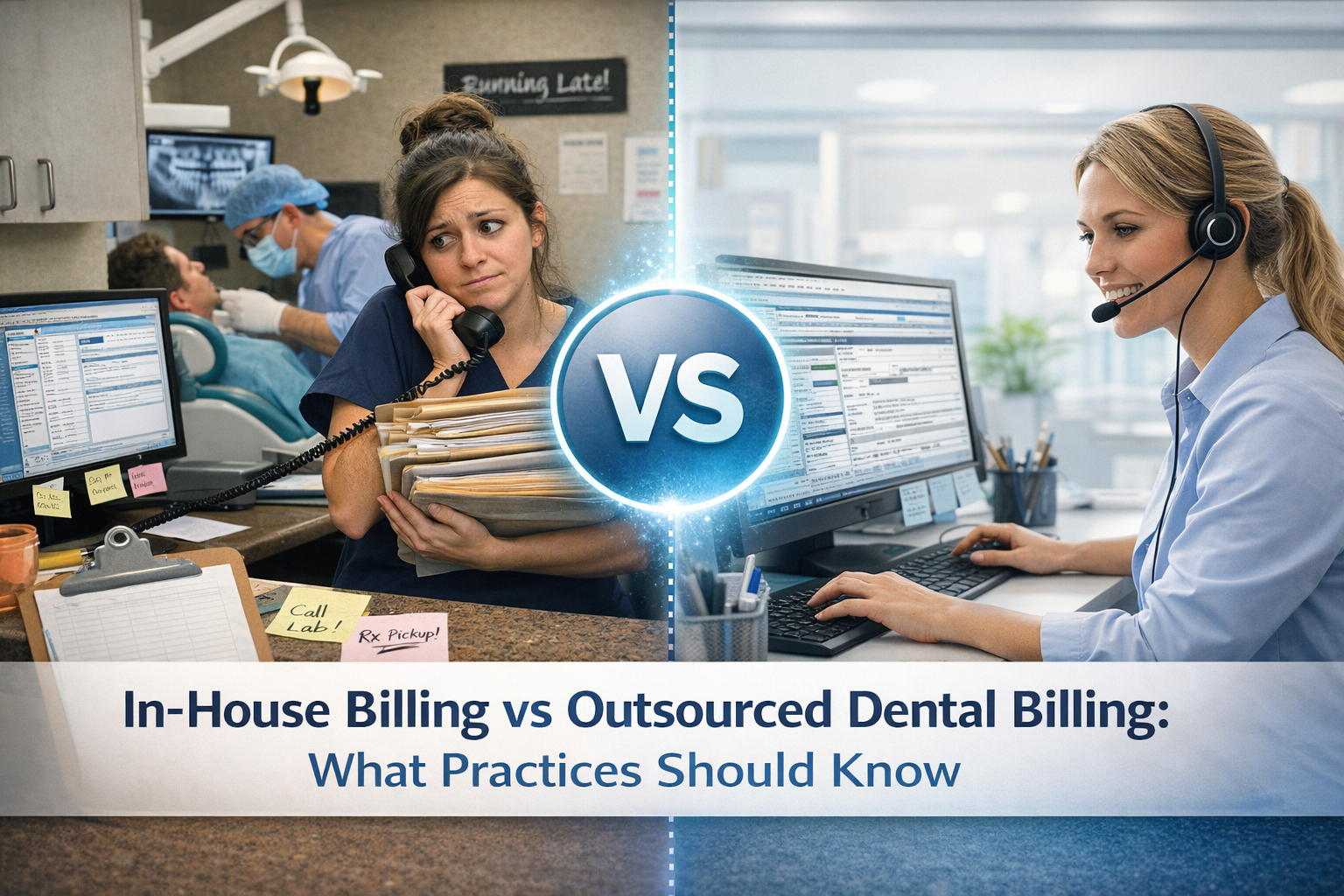
  • In-House Billing vs Outsourced Dental Billing: What Practices Should Know

    In-House Billing vs Outsourced Dental Billing: What Practices Should Know

    Insurance billing plays a critical role in the financial health of a dental practice. Claims must be submitted correctly, follow-ups need to be consistent, and insurance payments must be interpreted accurately to maintain proper patient balances.

    For many practices, this responsibility falls on an in-house team member. However, as insurance processes become more complex, many offices are beginning to consider outsourced dental billing support.

    Understanding the differences between in-house billing and outsourced dental billing can help practices determine which approach best supports their workflow and financial goals.


    How In-House Billing Typically Works

    In many dental practices, billing responsibilities are handled by a front office team member. These individuals often manage several roles simultaneously, including:

    • patient check-in and scheduling
    • treatment coordination
    • answering phones
    • financial arrangements
    insurance claim submission and follow-up

    While this structure works for some practices, insurance billing can quickly become time-consuming. Claims that require additional documentation, appeals, or repeated follow-up calls may compete with the daily demands of the front desk.

    When this happens, insurance follow-up may unintentionally become delayed, allowing claims to age beyond 60 or 90 days.


    Common Challenges With In-House Billing

    Front office teams are essential to the patient experience, but insurance billing often requires dedicated time and focus.

    Some common challenges practices encounter with in-house billing include:

    Limited time for insurance follow-up
    When staff members are managing patient flow and administrative tasks, insurance calls and claim reviews may get pushed aside.

    Insurance rules and coordination complexities
    Topics like coordination of benefits, fee schedules, and insurance adjustments require a deep understanding of how plans process claims.

    Training and knowledge gaps
    Many billers learn insurance workflows informally, which can lead to inconsistent billing practices over time.

    Aging insurance claims
    Without consistent follow-up systems, claims can sit unpaid for extended periods, creating delays in revenue.


    What Outsourced Dental Billing Looks Like

    Outsourcing dental billing allows practices to work with a team that focuses specifically on insurance management.

    Rather than relying on one person within the office, an external billing partner manages tasks such as:

    • insurance claim submission
    • claim follow-up and status tracking
    • coordination of benefits calculations
    • appeals and resubmissions
    • payment posting support
    • identifying aging accounts

    Because billing teams focus exclusively on insurance processes, they often have the time and structure needed to maintain consistent follow-up on outstanding claims.


    Benefits of Outsourcing Dental Billing

    For many practices, outsourcing billing is less about replacing the front office and more about supporting the team with dedicated insurance expertise.

    Some of the benefits practices often experience include:

    More Consistent Claim Follow-Up

    Insurance follow-up requires persistence and organization. A dedicated billing team can ensure claims are reviewed and followed up on regularly so they do not quietly age without resolution.

    Reduced Administrative Burden

    Front office teams can focus on patient interactions, scheduling, and treatment coordination rather than spending hours navigating insurance phone systems.

    Greater Insurance Billing Expertise

    Billing professionals who work specifically with insurance claims often develop a deeper understanding of topics such as:

    • coordination of benefits calculations
    • insurance fee schedules
    • documentation requirements
    • appeal strategies

    Improved Visibility Into Insurance Aging

    With structured billing workflows, practices often gain better insight into their insurance aging reports and claim status.


    Is Outsourced Billing Right for Every Practice?

    Outsourcing billing is not the right solution for every office. Some practices have well-established internal billing teams and processes that work effectively.

    However, many offices find that as insurance requirements become more complex, having dedicated support for billing and claims management helps maintain consistent revenue flow.

    The decision often depends on factors such as:

    • claim volume
    • staffing availability
    • time spent on insurance follow-up
    • comfort level with insurance processes


    A Collaborative Approach

    Outsourced billing does not replace the role of a practice’s front office team. Instead, it can function as an extension of the practice, working alongside the office to ensure insurance claims are submitted accurately and followed up on consistently.

    When insurance workflows are organized and claims receive the attention they require, practices often experience fewer delays and clearer financial records.


    Final Thoughts

    Dental insurance billing continues to evolve, and the complexity of insurance rules can make consistent follow-up challenging for busy offices.

    Whether a practice chooses to manage billing internally or partner with a billing team, the most important factor is ensuring that claims receive the attention necessary to maintain healthy revenue cycles.

    For practices that are evaluating their current billing workflows, reviewing aging claims and follow-up systems can be a helpful first step.


    Steadfast Billing Solutions partners with dental practices to support insurance billing workflows, helping offices manage claims, follow-ups, and insurance processes with consistency and attention to detail.

    If you’re curious how your current billing process compares, we’re always happy to review insurance aging reports and provide insight into potential opportunities for improvement.