
Tag: Insurance Claim Denials

  • Why EFT Payments Are Safer for Dental Practices Than Checks or Virtual Credit Cards

    Why EFT Payments Are Safer for Dental Practices Than Checks or Virtual Credit Cards

    Dental insurance payments can be issued in several ways, including paper checks, virtual credit cards (VCC), and electronic funds transfer (EFT Payments).

    Understanding the implications of each payment method is crucial for dental practices aiming to optimize their financial operations. In the following sections, we will delve deeper into the advantages of EFT, providing practical examples and insights into how these benefits can manifest in daily operations.

    Moreover, let’s explore how EFT enhances the overall patient experience by ensuring that insurance claims are processed efficiently, leading to quicker turnaround times for reimbursements and less hassle for both staff and patients.

    While all three methods are used across the industry, EFT is widely considered the most secure and efficient option for dental practices.

    Beyond faster payments, EFT can also help reduce administrative work and lower the risk of internal financial issues.

    By adopting EFT Payments, dental practices can enhance their operational efficiency and security.

    Understanding the differences between these payment methods can help practices make better decisions about how they receive insurance reimbursements.


    What Is EFT in Dental Insurance?

    This not only saves time but also reduces the likelihood of errors associated with manual processing of checks or virtual card payments. The electronic nature of EFT minimizes human intervention, thereby enhancing accuracy.

    Electronic Funds Transfer (EFT) is a modern banking process that allows insurance companies to deposit claim payments directly into a dental practice’s bank account, providing a seamless and efficient financial transaction method.

    Instead of waiting for a check in the mail or manually processing a virtual credit card, the payment is transferred electronically and typically appears in the account within a few days of claim processing.

    Additionally, EFT transactions can often be tracked in real-time, allowing practices to maintain accurate records and follow up on payments more effectively when needed.

    Moreover, faster payment processes can lead to improved relationships with vendors and suppliers, as timely payments may enhance trust and negotiation power.

    This is particularly important in a busy dental practice where cash flow is vital for meeting operational costs and investing in equipment and staff development.

    Most dental insurers offer EFT enrollment through clearinghouses or services such as CAQH EnrollHub.


    Why EFT Is Often the Best Option for Dental Practices

    With the complexity of insurance reimbursements, having a streamlined process via EFT simplifies the reconciliation of payments, as these are often accompanied by detailed reports outlining the payments received.

    By reducing the number of manual processes, practices can allocate their resources more effectively, allowing the administrative staff to focus on patient interactions and care rather than paperwork.

    Faster Payments

    Automated payment systems linked to EFT also allow for better forecasting of cash flow, enabling practices to make more informed financial decisions.

    Paper checks must be printed, mailed, received, deposited, and cleared by the bank.

    EFT payments skip several of these steps, allowing funds to be deposited directly into the practice’s account. This often results in faster access to funds and improved cash flow.


    Reduced Administrative Work

    Processing insurance checks requires staff to:

    • Open mail
    • Post payments manually
    • Deposit checks
    • Reconcile payments with EOBs

    EFT payments simplify this process because the funds arrive electronically and are typically paired with electronic remittance advice (ERA) that can be imported into dental software.

    This can save significant administrative time for front office teams.


    Enhanced Financial Control

    With EFT, practices can implement features that allow for better auditing and tracking of transactions, ensuring that every payment is accounted for and accurately reflected in the practice’s financial statements.

    Additionally, this transparency can serve as a deterrent to potential internal fraud, as fewer touch points and more visible transactions make misconduct more difficult.

    A dental practice that previously experienced issues with lost checks could utilize EFT to ensure that funds are securely deposited, drastically reducing the chance for error or misappropriation.

    Virtual credit cards may also complicate the reimbursement process, often requiring additional steps for manual processing that could inadvertently lead to missed payments.

    This complexity often leads to frustration among staff who have to navigate both the virtual card systems and traditional payment methods, further emphasizing the efficiency of EFT.

    Paper checks can be delayed in the mail, lost in transit, or occasionally misdirected.

    Practices should consider educating their staff on the benefits of EFT over VCC, ensuring that everyone understands the financial implications of their payment choices.

    Because EFT payments move electronically between the insurance company and the practice’s bank, there is less risk of payment delays due to mailing issues.


    Reduced Risk of Internal Embezzlement

    One of the less discussed advantages of EFT payments is the additional financial transparency they provide.

    When insurance checks arrive by mail, they must be handled by staff before being deposited. In some situations, this can create opportunities for payments to be diverted or mishandled.

    Ultimately, the transition to EFT can lead to a smoother financial operation, with fewer headaches related to payment discrepancies and a more streamlined process for handling claims.

    Because EFT payments are deposited directly into the practice’s bank account, they reduce the number of touchpoints where funds are handled manually.

    For practices looking to enhance their billing processes, integrating EFT is a step forward that can save time, reduce costs, and improve overall financial health.

    In conclusion, as the dental industry continues to evolve, adopting modern payment methods like EFT is not merely a trend but a necessity for practices aiming to thrive in a competitive landscape.

    This can help practices maintain stronger financial controls and reduce opportunities for internal misappropriation.


    What About Virtual Credit Card Payments?

    Some insurance companies issue payments through virtual credit cards (VCC).

    With this method, the practice receives a credit card number that must be manually processed like a card payment.

    While VCC payments may arrive faster than paper checks, they often come with processing fees similar to merchant card fees.

    These fees can reduce the total reimbursement the practice receives for insurance claims.

    For this reason, many practices prefer to request EFT instead of virtual credit card payments whenever possible.


    The Bottom Line

    Electronic Funds Transfer offers several advantages over traditional insurance payment methods.

    By enrolling in EFT, dental practices can often benefit from:

    • Faster insurance payments
    • Reduced administrative workload
    • Improved payment tracking
    • Lower risk of lost checks
    • Reduced opportunities for financial misconduct

    For many practices, moving toward EFT payments is a simple change that can improve both efficiency and financial transparency.


    Need Help Optimizing Your Dental Billing Process?

    Managing insurance payments, claim follow-ups, and revenue cycle processes can take significant time away from patient care.

    Steadfast Billing Solutions helps dental practices streamline their billing systems and improve insurance reimbursement workflows.

    Learn more at:
    www.steadfastbilling.com

    Phone:
    361-273-0004
  • Dental Bone Graft CDT Codes: D7953 vs D7950 vs D6104 Explained

    Dental Bone Graft CDT Codes: D7953 vs D7950 vs D6104 Explained

    Dental bone graft CDT codes can get confusing fast—especially when procedures happen at different stages of treatment.

    Let’s be honest…

    Most denials we see here aren’t because the procedure was wrong.

    It’s because the wrong code was used—or the situation wasn’t clearly understood when it was billed.

    And this is where things start to slip.


    Understanding Bone Graft CDT Codes in Implant Cases

    The biggest difference between these comes down to one thing:

    👉 Timing and purpose

    Not just what was done…

    But when it was done and why.


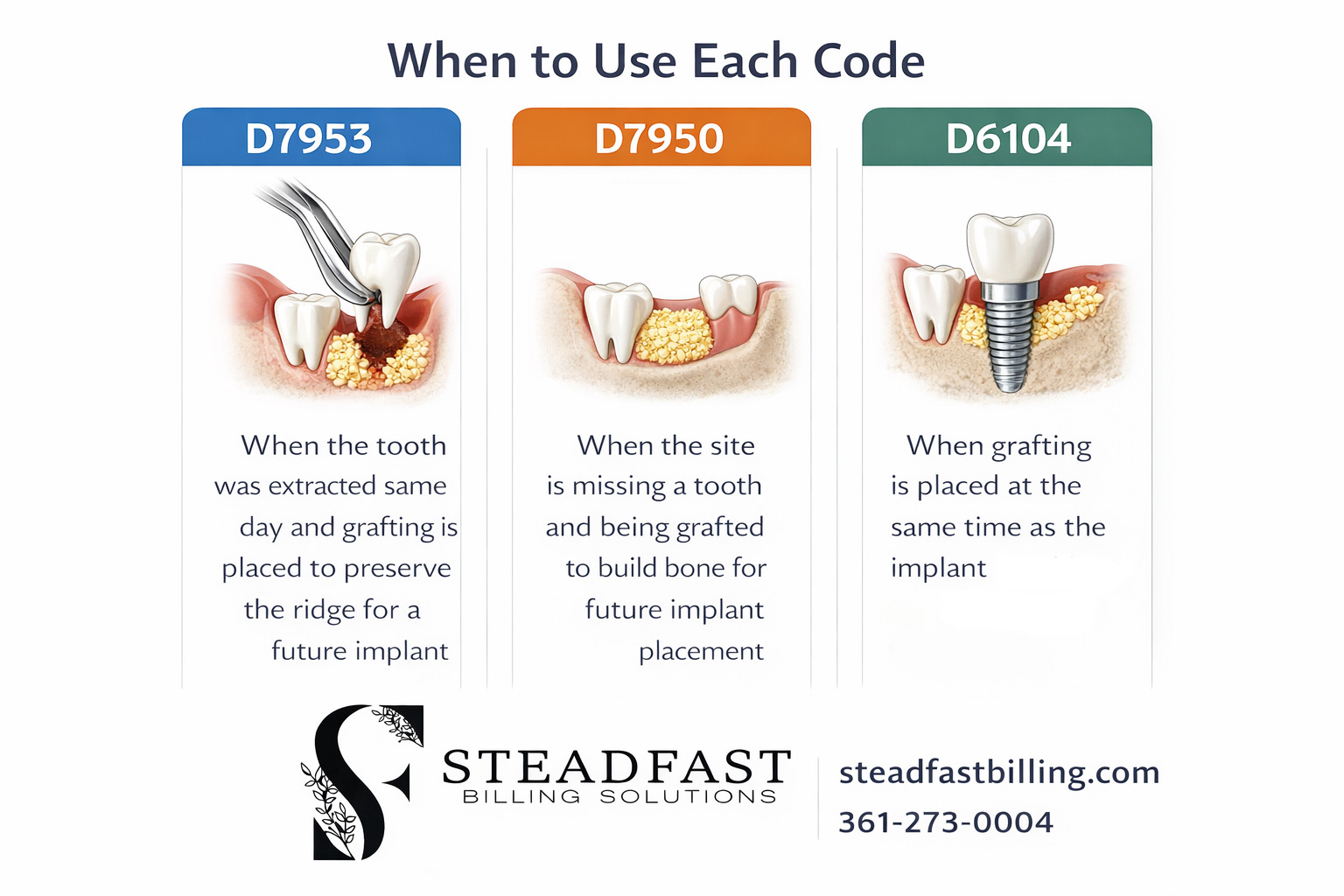
    D7953 — Ridge Preservation at Time of Extraction

    D7953 is used when this procedure is performed at the same time as a tooth extraction.

    The goal is to preserve the site so it’s ready for future placement.

    When to Use It

    • Same day as extraction
    • Site preservation for future treatment
    • Submitted with extraction

    What Trips Offices Up

    Some insurance plans tie this directly to future treatment.

    So if there’s no pre-determination—or that future service gets denied…

    👉 this may be denied too


    D7950 — Used for Ridge Augmentation or Defect Repair

    D7950 applies when the procedure is done to:

    • Build up the ridge
    • Repair defects
    • Prepare an area for future restoration

    And it’s not tied to an extraction site.

    When to Use It

    • Separate procedure
    • More extensive cases
    • Site development for future needs

    Common Area of Confusion

    A big one we see?

    Primary teeth.

    If a baby tooth is extracted and additional work is done, it’s easy to assume it should be tied to that extraction.

    But if the goal is to support the future permanent tooth site…

    👉 it’s often considered separate

    Which is why D7950 is typically the correct code in these situations.


    D6104 — Performed at Time of Implant Placement

    D6104 is used when this procedure is done during placement of an implant.

    This usually happens when:

    • Additional support is needed
    • There are defects around the area

    When to Use It

    • Same time as placement
    • Supports stability
    • Requires clear documentation

    Key Differences Between D7953, D7950, and D6104

    CodeWhen It’s UsedTiming
    D7953Ridge preservationAt time of extraction
    D7950Ridge augmentation or defect repairSeparate procedure
    D6104Procedure performed with implant placementAt time of implant placement

    👉 If you get the timing wrong… you usually get the claim wrong.


    Why Correct Coding Impacts Your Revenue

    This isn’t just about accuracy.

    It directly affects your collections.

    Using the correct code helps prevent:

    • Denials that shouldn’t happen
    • Delayed payments
    • Rework and resubmissions
    • Write-offs that could have been avoided

    What Insurance Actually Looks For

    Most carriers aren’t just looking at the code.

    They’re looking for:

    • Clinical necessity
    • Clear timing
    • Supporting documentation (radiographs, notes)

    If that’s missing—or unclear…

    They default to denial.


    The Bigger Issue Behind the Scenes

    Your team is busy.

    They’re juggling:

    • patients
    • phones
    • schedules
    • and billing

    So decisions get made quickly.

    Sometimes based on habit.

    Sometimes based on assumption.

    And not because they don’t care…

    But because they don’t always have the time to slow down and think through the details.


    The Bottom Line

    These procedures play a big role in long-term success.

    But billing them correctly comes down to understanding:

    👉 when the procedure was done
    👉 what it was meant to support

    That’s what determines the right code.

    And when that part is clear…

    Everything else gets easier.


    Need Help With Dental Billing?

    If coding and billing around these procedures feels inconsistent…

    We offer a free billing analysis so you can see what’s actually happening behind the scenes—what’s being missed, and where things can be cleaned up.

    No pressure.

    Just clarity.

    Dental insurance billing can quickly become complicated, especially when procedures involve multiple codes and documentation requirements.

    Steadfast Billing Solutions helps dental practices manage insurance claims, follow-ups, and revenue cycle processes so offices can focus on patient care.

    Learn more at:
    www.steadfastbilling.com

    Phone:
    361-273-0004

  • Understanding Non-Covered Benefits in Dental Insurance: A Common Source of Billing Confusion

    Understanding Non-Covered Benefits in Dental Insurance: A Common Source of Billing Confusion

    Dental insurance billing can be complicated, and one area that often causes confusion for dental offices is non-covered benefits. Misunderstanding how these benefits work can lead to incorrect adjustments, lost revenue, and inaccurate patient balances.

    Many offices assume that if an insurance company does not pay for a procedure, it must automatically be considered a non-covered benefit. In reality, that is not always the case. Understanding the difference between a service that is truly not covered and a service that is covered just simply not payable is essential for accurate billing.


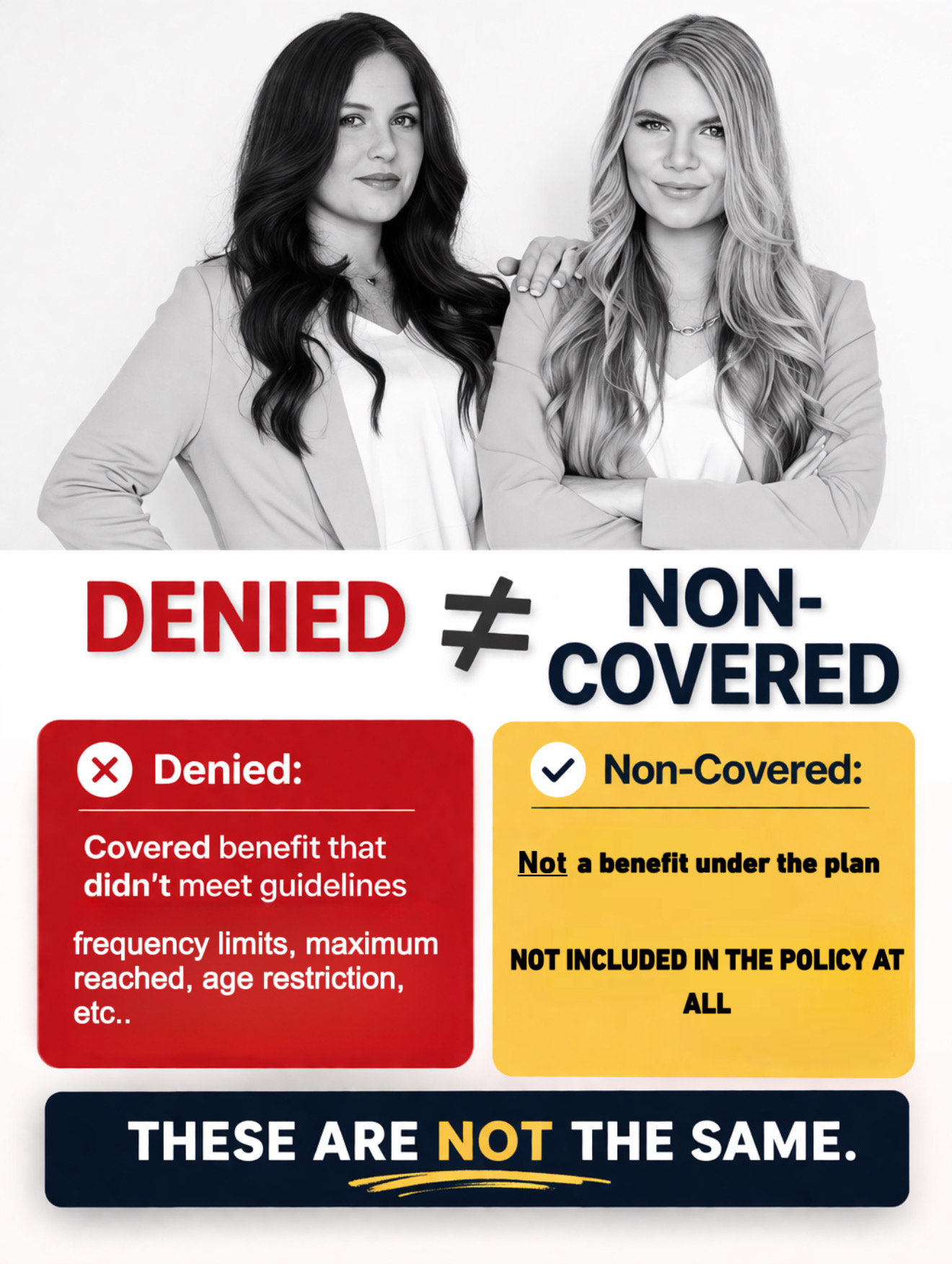
    What Is a True Non-Covered Benefit?

    This refers to a dental procedure that is never covered under the patient’s insurance policy. The service simply does not exist within the plan’s list of covered benefits.

    When verifying insurance coverage, the insurance company may clearly state that a procedure is “not a covered benefit.” In these situations, the service is outside the scope of the patient’s policy entirely.

    In many states, when a service is truly not covered under the policy, dental practices are generally allowed to charge the full office fee rather than being restricted to the contracted in-network fee schedule.

    Understanding this distinction is important because incorrectly applying a contractual adjustment in these situations can result in unnecessary revenue loss for the practice.


    When a Procedure Is Covered but Not Payable

    One of the most common billing mistakes occurs when offices assume that any unpaid claim automatically qualifies as a non-covered benefit.

    However, if a procedure would normally be covered under the patient’s insurance policy but is denied due to plan limitations or guidelines, it is still considered a covered benefit, even though the insurance company did not issue payment.

    Common examples include:

    • Frequency limitations (such as exams or cleanings performed too soon)
    • Plan waiting periods
    • Missing documentation or required attachments
    • Plan-specific coverage guidelines

    In these situations, the procedure remains part of the plan’s covered services, even though payment was denied for that particular claim.

    Because the service is still considered a covered benefit, participating providers are typically required to honor the contracted in-network fee schedule, meaning the patient must receive the negotiated insurance discount.


    Why This Distinction Matters

    Failing to correctly identify whether a procedure is truly not covered or a covered service that is simply not payable can create significant billing problems.

    Some of the most common issues we see include:

    • Incorrect contractual adjustments
    • Loss of revenue due to unnecessary fee reductions
    • Inaccurate patient balances
    • Confusion when explaining charges to patients

    Over time, these small errors can quietly add up and impact the financial health of a practice.


    The Importance of Understanding Insurance Contracts

    Every dental insurance participation agreement outlines how providers must handle billing for covered and non-covered services.

    Because policies vary between carriers and states, correctly interpreting insurance responses requires careful review of:

    • explanation of benefits (EOBs)
    • participation agreements
    • plan benefit structures
    • state guidelines regarding non-covered services

    Without a clear understanding of these details, billing errors can easily occur.


    Clear Communication With Patients

    When procedures are not paid by insurance, patients often assume the office made an error. Being able to clearly explain why a service was not covered helps maintain transparency and trust.

    Dental teams should take the time to:

    • verify benefits when possible before treatment
    • review EOB explanations carefully
    • explain the difference between non-covered benefits and plan limitations

    Providing clear financial explanations helps patients better understand their insurance coverage and prevents confusion later.


    Final Thoughts

    Dental insurance billing is filled with small details that can have a significant impact on practice revenue. The difference between a true non-covered benefit and a covered procedure that simply did not pay may seem minor, but it can dramatically affect how fees and adjustments should be applied.

    Unfortunately, this distinction is one of the most commonly misunderstood areas of dental billing.

    At Steadfast Billing Solutions, we frequently review accounts where incorrect adjustments were made simply because denied vs not a covered benefit rules were misunderstood. These mistakes often lead to lost revenue and unnecessary confusion for both practices and patients.

    When insurance billing is handled with careful attention to plan details, participation agreements, and fee schedule rules, practices can avoid these issues and maintain accurate financial records.

    If your office has ever questioned whether adjustments are being applied correctly—or if you simply want a second set of eyes on your billing processes—a professional billing review can often reveal opportunities to improve accuracy and protect revenue.

    Steadfast Billing Solutions partners with dental practices to ensure claims, adjustments, and insurance workflows are handled correctly so offices can focus on what matters most: providing exceptional patient care.

  • Coordination of Benefits in Dental Billing: The Most Common Mistakes That Cost Practices Money

    Coordination of Benefits in Dental Billing: The Most Common Mistakes That Cost Practices Money

    Insurance billing can be one of the most complex parts of running a dental practice, and Coordination of Benefits (COB) is often where mistakes happen most frequently.

    In fact, one of the most common issues we see when reviewing accounts is incorrect COB adjustments. These errors can create inaccurate balances, incorrect credits, and in some cases even cause practices to lose revenue.

    Many billers learn insurance workflows informally—often from someone who was also self-taught. Over time, incorrect methods get passed down and become the standard in an office even though the calculations may not be accurate.

    Understanding how Coordination of Benefits actually works can make a significant difference in maintaining accurate accounts and protecting your practice’s revenue.


    Understanding Coordination of Benefits

    Coordination of Benefits occurs when a patient has more than one dental insurance plan.

    In these situations:

    1. The primary insurance plan processes the claim first.
    2. The secondary insurance plan processes the remaining balance based on its coordination rules.

    The goal of COB is to ensure the total payment from both insurance companies does not exceed the allowable amount determined by the plans.

    However, the way this calculation happens can vary depending on the state and plan rules, which is where many mistakes occur.


    Low Fee Schedule vs High Fee Schedule States

    One critical factor that affects COB calculations is whether a state follows Low Fee Schedule Coordination or High Fee Schedule Coordination.

    Low Fee Schedule Coordination

    In a Low Fee Schedule state, the adjustment is based off the lowest fees between both fee schedules.

    High Fee Schedule Coordination

    In High Fee Schedule states, the adjustment is based off the highest fees between both fee schedules.

    Understanding which method applies is critical because the calculation must account for both fee schedules on a per code basis.


    A Common Billing Mistake

    One of the most frequent errors we see is when billers calculate adjustments using only one fee schedule.

    For example:

    • Adjusting solely based on the primary insurance allowable
    • Adjusting solely based on the secondary insurance allowable

    Both of these approaches can lead to incorrect account adjustments.

    Proper COB calculation requires evaluating both fee schedules together to determine the correct remaining allowable amount.


    The Overpayment Misconception

    Another common misunderstanding involves overpayments.

    Many billers assume that if an insurance payment is higher than the plan’s allowable amount, it automatically means an overpayment occurred.

    However, that is not always the case.

    Insurance payments may appear higher than expected due to:

    • Coordination of Benefits calculations
    • Plan provisions
    • deductible differences
    • remaining annual benefits

    Automatically applying adjustments without reviewing the full calculation can create incorrect account credits or cause practices to refund money unnecessarily.


    Why Accurate COB Matters

    When Coordination of Benefits is calculated incorrectly, it can lead to several issues:

    • Incorrect patient balances
    • Credits appearing on accounts when they shouldn’t exist
    • Missed revenue opportunities
    • Time spent correcting account errors later

    For busy practices, these issues can quietly accumulate over time.


    The Value of Proper Insurance Review

    Because COB rules can vary between plans and states, accurate coordination requires careful review of:

    • primary plan fee schedules
    • secondary plan fee schedules
    explanation of benefits (EOB) details
    • state coordination guidelines

    Taking the time to ensure COB calculations are correct helps maintain accurate accounts and predictable revenue flow.


    Final Thoughts

    Coordination of Benefits is one of the most misunderstood aspects of dental insurance billing, yet it plays a critical role in maintaining accurate financial records within a practice.

    When calculated correctly, COB ensures that insurance payments are applied properly and accounts remain balanced.

    If your practice has ever questioned whether your coordination adjustments are being handled correctly, it may be worth reviewing your current billing workflows.


    Steadfast Billing Solutions works with dental practices to ensure insurance claims, coordination calculations, and billing processes are handled accurately so offices can focus on patient care while maintaining healthy revenue cycles.