-

What Is Dental Billing? A Clear Overview for Dental Practices
Dental billing is the process of submitting and following up on claims for payment for dental services provided to patients. It encompasses all activities that collect payment for dental work performed in a practice. Payment comes in two forms: insurance payment and patient payment. For any dental practice that works with insurance companies, understanding dental…
-

Dental Practice Embezzlement Prevention: Protect Your Revenue
The American Dental Association estimates that as many as 30 percent of dental practices experience some form of employee theft or embezzlement. For a practice generating $1 million in annual revenue, a typical embezzlement scheme can drain $50,000 to $100,000 or more before detection. That is lost profit, lost investment, and lost trust. Preventing embezzlement…
-
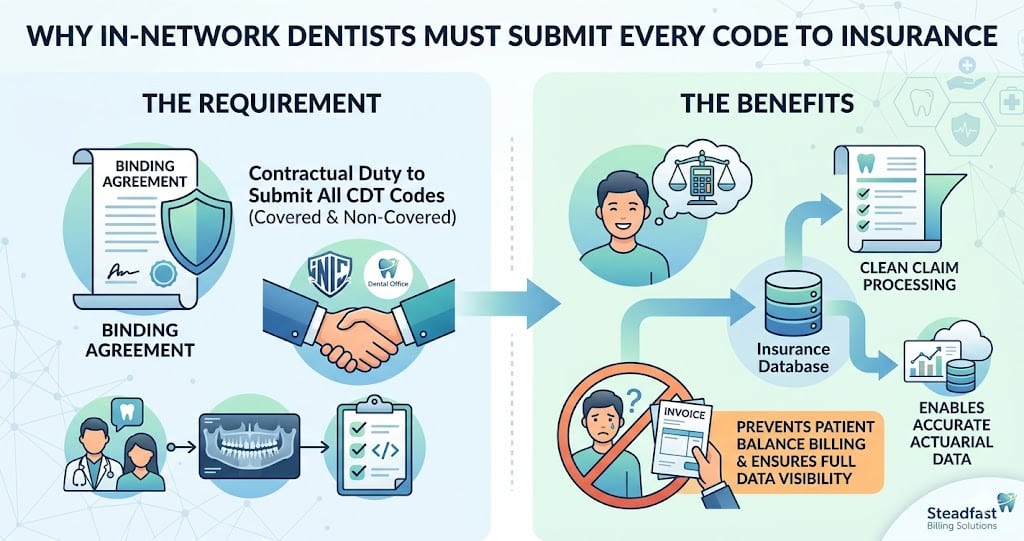
Why an In-Network Dentist Must Submit Every Code to Insurance
When a practice signs an in-network contract with an insurance carrier, the agreement comes with a clear mandate: an in-network dentist must submit every code to insurance as they must report every procedure performed, regardless of whether the plan covers that specific service. This obligation, rooted in both the contract and federal regulations, protects patients…
-

How Dental Billing Services Transform Practice Revenue and Efficiency
A dental practice’s average claim denial rate hovers near 15%, directly draining tens of thousands of dollars in potential revenue each year. This persistent leakage isn’t just about insurance company policies; it’s often a symptom of an overburdened internal system. This is where specialized dental billing services shift from a cost line to a critical…
-

Medical Cross Coding for Oral Surgery Procedures: A Financial Imperative
Medical Cross Coding for Oral Surgery Procedures Oral surgeons send over 30% of their major claims to medical insurers. Yet, a high number are denied or underpaid. This happens because of incorrect coding. This is not just a small error. It is a revenue leak that costs a practice thousands of dollars each year. Medical…
-

The True Value of a Free Dental Billing Audit for Your Practice
Dental practices consistently lose between 5% and 15% of their annual revenue to billing errors and inefficient processes. A free dental billing audit is the most direct method to identify these leaks before they drain your profitability. This no-cost examination of your billing systems provides a clear snapshot of your revenue cycle health without financial…
-
AI in the Dental Front Office: Hype vs. Reality
Achieving peak dental AI front office efficiency is no longer a luxury; it is a necessity for modern practices. As we move further into 2026, the gap between tech-forward offices and those relying on manual entry is widening. At Steadfast Billing Solutions, we have seen firsthand how the right balance of automation and human expertise…
-

The In-Between Code: D4346 vs D1110 vs D4341
Understanding the latest D4346 dental billing guidelines is essential for practices that want to bridge the clinical gap between a standard prophy and SRP. For years, dental hygiene coding felt like a binary choice: either the patient was “healthy” (D1110) or they had “bone loss” (D4341/D4342). This left a massive clinical gap for patients with…
-

The $20K Weight: Is Your Practice Sitting on a Patient Credit Balance Time Bomb?
Managing dental patient credit balances is one of the most overlooked aspects of dental billing, yet it is incredibly common for offices to be holding $20,000 or more in these funds. While it might look like a safety net on your aging report, those funds don’t actually belong to the practice, and holding onto them…
Dental Billing Insights
© 2026 Steadfast Billing Solutions. All rights reserved.