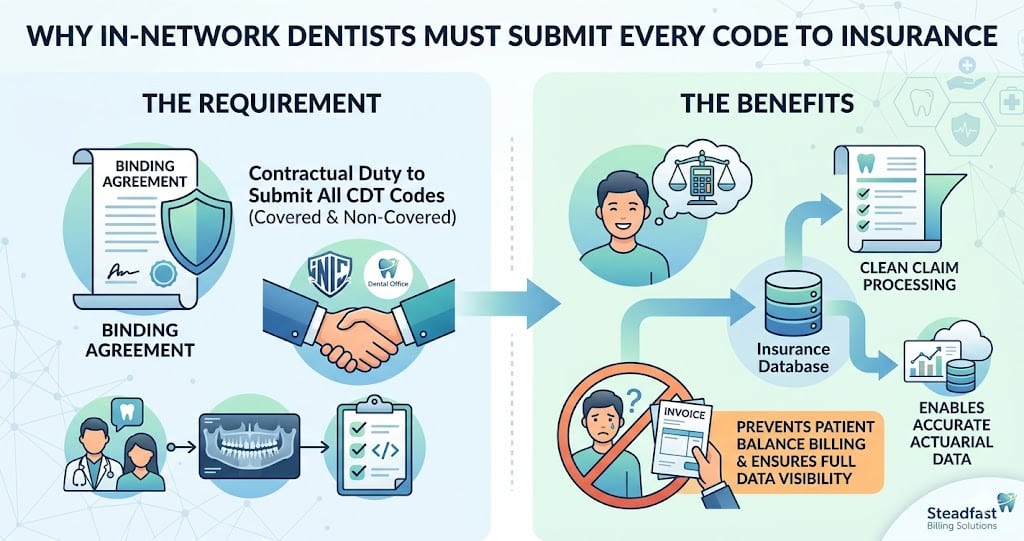
When a practice signs an in-network contract with an insurance carrier, the agreement comes with a clear mandate: an in-network dentist must submit every code to insurance as they must report every procedure performed, regardless of whether the plan covers that specific service. This obligation, rooted in both the contract and federal regulations, protects patients from surprise bills and ensures carriers have full visibility into treatment patterns. Yet many dental offices misinterpret the requirement, either omitting non-covered codes or billing patients directly for services that should first pass through the carrier. The consequences range from clawbacks and contract termination to compliance audits. Insurance carriers increasingly use automated systems to cross-reference clinical notes with submitted codes, making omissions easy to detect.
Misunderstanding full code submission requirements can cost a practice tens of thousands of dollars annually in clawbacks and lost revenue. The following sections examine the contractual language, common pitfalls around CDT code submission, and practical steps to remain compliant while maximizing legitimate revenue.
Why an In-Network Dentist Must Submit Every Code to Insurance Under Contract
Every participating provider agreement contains a provision stating that the in-network provider requirements include the submission of all charges for services rendered to an insured patient. Insurance companies phrase this as a “clean claim” obligation, but the definition extends beyond formatting. The true requirement is that the dental claim processing system receives every CDT code that accurately describes the procedure, even if the code is considered non-covered or not eligible under the patient’s benefit plan.
Failure to follow this protocol constitutes a breach of contract. Carriers routinely audit claims histories and cross-reference patient records. When they discover that a provider omitted a code, they may demand repayment for all related services and sometimes terminate the provider agreement entirely. For a practice that relies on a steady flow of in-network patients, that risk is existential.
The logic behind the rule is straightforward: insurance companies price their premiums and networks based on actuarial data. If they only see partial data from providers, their pricing models become inaccurate. They also want to prevent balance billing scenarios where a patient receives a service, the provider submits only covered codes, and then the patient receives a separate bill for the unsubmitted service. That practice, called “disentangling,” violates most state insurance regulations.
Where Practices Commonly Go Wrong with Code Submission
Omitting Non-Covered Benefits
The most frequent error occurs when a dentist performs a procedure that the plan categorizes as a non-covered benefit. For example, a panoramic X-ray for orthodontic evaluation or a surgical extraction that the plan excludes. The team, trying to be helpful, might skip submitting that code because “the insurance won’t pay anyway.” This is a violation. The contract requires submission of all codes, not just payable ones.
In many policies, non-covered benefits still apply toward a patient’s deductible or maximum. When omitted, the patient may unknowingly be billed at a higher out-of-pocket rate than they should. And if the carrier discovers the omission during an audit, they can recalculate the entire claim and demand a refund.
Using Incorrect CDT Codes to Fit a Patient’s Plan
Some billers change a CDT code to a different one that is more likely to be paid, rather than submitting the true code. This practice, known as “denial avoidance,” is a form of insurance fraud. Even if the intention is to help the patient, using a code that does not describe the actual procedure violates both dental coding guidelines and the provider contract. Accurate code submission is not optional.
Skipping Pre-Authorization as a Workaround
Dental pre-authorization may not be required for every procedure, but when a carrier requests it, the submission of the planned codes during the pre-auth step is separate from the claim itself. Some practices assume that if pre-authorization was denied, they do not need to submit the claim. They are incorrect. The in-network contract demands claim submission regardless of prior denial. The carrier needs the claim to formally process the denial and to track the patient’s benefits.
The Role of the Dental Fee Schedule in Submission Compliance
The dental fee schedule that accompanies an in-network contract establishes the maximum allowable fee for each CDT code. When a practice submits all codes, the carrier applies the fee schedule and calculates the patient’s copayment and the carrier’s payment. If a code is omitted, the fee schedule for that code is never triggered, and the patient may be left with a balance that should have been covered.
Insurance claim codes must always be submitted with the full billed charge, even if the fee schedule will reduce it. Carriers expect to see the practice’s usual fee, not an arbitrary amount. Submitting a reduced fee to avoid a contract violation is itself a misrepresentation. The correct approach is to submit the true usual and customary fee, then let the fee schedule do its work.
How Insurance Claim Processing Checks for Compliance
Carriers use automated edit engines to flag claims where a provider consistently omits certain codes. For example, if a practice performs a high volume of oral surgery procedures but never submits adjacent diagnostic codes like D024 (intraoral occlusal film), the system may trigger a review. Similarly, if a provider’s claim submission patterns change abruptly or deviate significantly from peer profiles, an investigation begins.
During an audit, the carrier compares the submitted claims against clinical notes, radiographs, and treatment plans. Any missing codes become evidence of non-compliance. The penalties can include recoupment of payments for all affected patients, monetary fines, and exclusion from the network.
Practices often underestimate how sophisticated cost analysis tools have become. Carriers now have access to artificial intelligence that can predict expected code combinations based on the procedure and tooth number. A routine filling on tooth 19 without a diagnostic code or bitewing radiograph in the same visit automatically triggers a compliance check. The margin for error is thin.
Practical Steps for In-Network Dentists to Ensure Full Code Submission
Build a Standardized Clinical Documentation Checklist
Every clinical note must list every procedure performed, including diagnostic exams, radiographs, anesthetic administration (D9210 series), and adjunctive services. The front desk or billing team should code directly from this checklist, never from memory or habit. This reduces the chance of overlooking a routine code like D9120 (removal of restoration) that often goes unsubmitted.
Use a Clearinghouse That Validates Code Completeness
A clearinghouse is more than a pass-through. Many modern clearinghouses offer real-time edits that flag claims where the code bundle appears incomplete relative to the procedure. For example, if you submit a crown code D2740 without a preliminary code for the buildup or the core, the clearinghouse can raise an alert. Integrating these checks into the dental claim processing workflow catches omissions before the carrier sees them.
Train Staff on Insurance Billing Protocols
The administrative team must understand that their duty is to submit every code without editorial judgment. A helpful but misguided staff member who decides “the insurance won’t pay for this so I’ll save the patient a denial letter” is actually creating liability. Regular training sessions on insurance billing protocols should reinforce that submission is contractually required, not optional.
Conduct Internal Audits Using a Dental Billing Audit Service
Periodic audits performed by a third party can reveal patterns of omission that have become routine. An audit reviews a sample of claims against the clinical records and identifies any codes that were not submitted. Even a small practice can benefit from a quarterly review. For practices that lack the staff time, outsourcing to a dental billing audit service ensures impartial scrutiny and documented compliance.
When Full Submission Conflicts with Patient Communication
A natural tension arises when a patient asks, “Why are you billing my insurance for something they won’t cover?” The answer is simple: the contract requires it. But patients may perceive it as wasteful or intrusive. The practice should prepare a brief explanation: “Our agreement with your insurance company requires us to report every service we provide. This helps them maintain accurate records of your benefits and ensures that anything that does count toward your deductible is tracked properly.”
This scripting empowers the front desk to address concerns without getting into clinical details. It also positions the practice as a stickler for compliance, which builds trust.
The Intersection with Coordination of Benefits
Full code submission becomes even more critical when a patient has dual coverage. If only one carrier receives all codes while the second receives a partial list, the coordination of benefits process breaks down. The secondary carrier may underpay or deny benefits because they lack the full picture. Accurate submission to both carriers is essential for proper coordination of benefits, a topic we cover in depth in our article on [link: coordinating multiple insurance plans].
Missing codes also complicate the resolution of termed coverage. When a patient’s policy has ended but services were rendered while active, the carrier may require a complete code list to finalize the account. Incomplete submissions delay resolution and can lead to balance confusion for the patient.
Table: In-Network vs. Out-of-Network Code Submission Requirements
| Requirement | In-Network Provider | Out-of-Network Provider |
|---|---|---|
| Must submit every code performed | Yes, contractually required | Not required, but recommended for patient benefit tracking |
| Accept fee schedule reduction | Yes | No; patient pays the difference |
| Balance billing restricted | Yes; cannot bill patient above allowed amount | Allowed, within state limits |
| Pre-authorization often mandatory | Many plans require it | Usually not required |
| Carrier audits for completeness | Frequent and aggressive | Rare |
| Penalties for omitted codes | Recoupment, contract termination | Reduced payment, possible network exclusion if joining later |
How Steadfast Billing Solutions Supports Compliance
For practices that find the compliance burden too heavy to manage alongside patient care, partnering with an expert billing firm offers a clean solution. Steadfast Billing Solutions acts as an extension of your administrative team, ensuring that every claim submitted meets carrier requirements and that no code falls through the cracks. Our team lives inside the nuances of dental coding guidelines and in-network provider requirements. We do not process claims in a silo; we audit each submission against the clinical record and the contract terms.
Our dental insurance billing services include a detailed review of every fee schedule to confirm that the correct code set has been applied. We also manage dental claim processing from start to finish, including the retrieval of EOBs and the follow-up on any late payments. By outsourcing this function, your practice gains confidence that your submission practices are bulletproof.
We also offer a dental revenue cycle management approach that looks at the entire financial picture, not just claim submission. This includes dental pre-authorization follow-up, patient billing for non-covered services, and termed coverage resolution. Our goal is to make sure that the contractual requirement to submit all codes does not become a source of lost revenue or audit risk.
Frequently Asked Questions
What happens if an in-network dentist does not submit all codes to insurance?
The insurance company may require the practice to refund payments for related services, impose fines, or terminate the provider agreement. Repeated violations can lead to exclusion from the network entirely, which significantly reduces patient volume.
Does submitting a code for a non-covered service waste the patient’s time?
No. Even for non-covered services, the code must be submitted because it applies to the patient’s deductible and annual maximum. Also, some plans later apply a non-covered benefit to the out-of-pocket cap. Submitting ensures accurate benefit tracking.
Can a practice charge the patient directly instead of submitting a non-covered code to insurance?
No. Under most in-network contracts, the practice must submit all charges to the carrier first. Only after the carrier processes the claim and either pays or denies it can the practice bill the patient for any patient-responsible amount.
How often should a practice audit its claim submission compliance?
At least quarterly. More frequent audits are advisable for high-volume practices or those that have recently joined new networks. An audit can identify patterns of omission before they trigger a carrier investigation.
What are the consequences of using an incorrect CDT code to avoid a denial?
Using an incorrect CDT code is considered insurance fraud, even if no monetary loss occurs. Carriers and regulators view this as a serious compliance failure that can lead to recoupment, civil penalties, and legal action. Always submit the code that accurately describes the procedure performed.
Conclusion
The requirement that an in-network dentist submit every code to insurance is not a suggestion but a binding contractual duty. Practices that treat this obligation as optional expose themselves to audits, clawbacks, and potential network exclusion. By building robust documentation workflows, training staff on compliance, and leveraging expert support from a firm like Steadfast Billing Solutions, you can meet this requirement without sacrificing efficiency or profitability. The safest path is to submit every code, every time, and let the carrier process it as the contract dictates. Your practice, your patients, and your bottom line will benefit from that discipline.
Leave a Reply