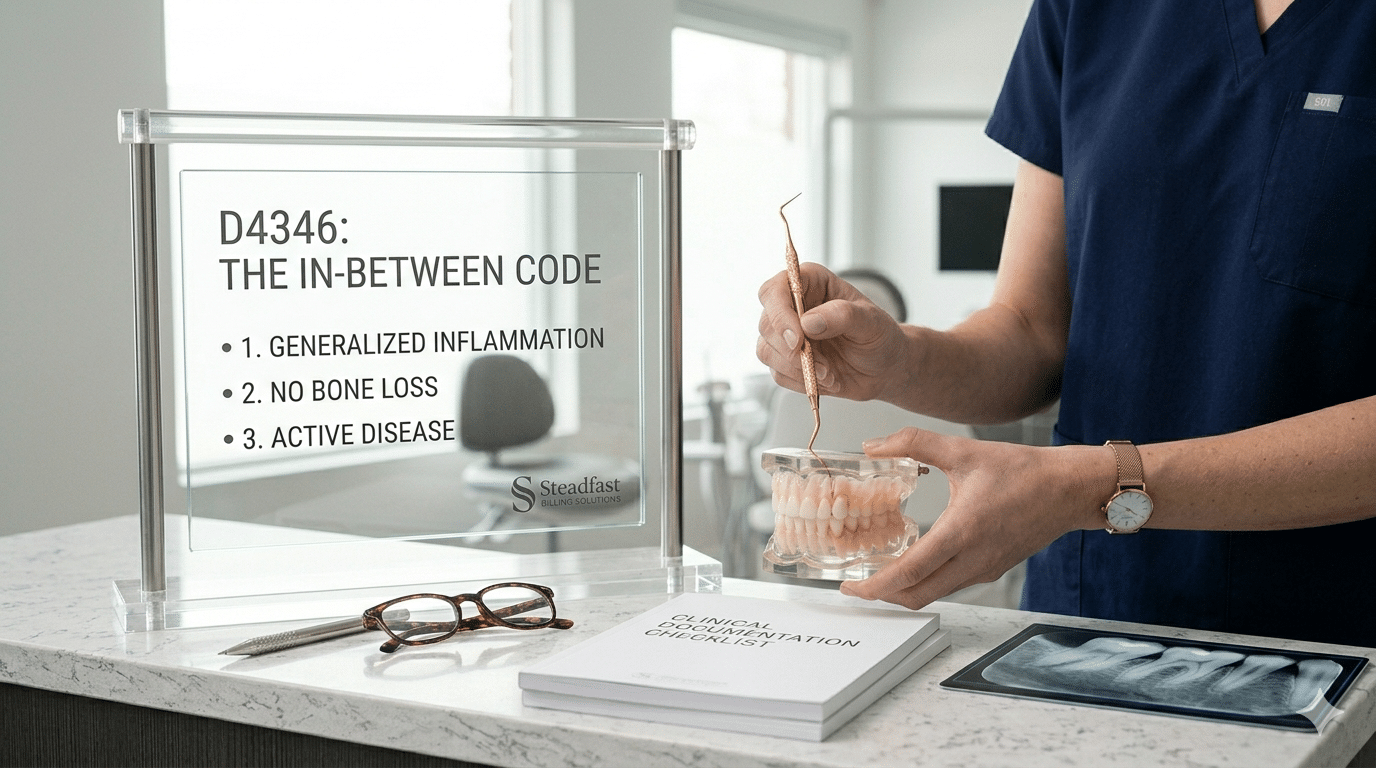
Understanding the latest D4346 dental billing guidelines is essential for practices that want to bridge the clinical gap between a standard prophy and SRP.
For years, dental hygiene coding felt like a binary choice: either the patient was “healthy” (D1110) or they had “bone loss” (D4341/D4342). This left a massive clinical gap for patients with heavy inflammation but no attachment loss.
Enter D4346. While it has been around for several years, it remains one of the most underutilized, and frequently denied, codes in the hygiene department.
Decoding the Differences: D4346 Dental Billing Guidelines & Framework
Understanding exactly where D4346 sits in the hierarchy is the first step to avoiding “downcoding” by insurance carriers.
| Code | Definition | Clinical Presentation |
| D1110 | Prophylaxis (Preventive) | Healthy tissue or slight gingivitis. Focus is on prevention. |
| D4346 | Scaling in Presence of Inflammation | Moderate-to-severe gingivitis without bone loss. Focus is on therapeutic treatment. |
| D4341/D4342 | Scaling & Root Planing (SRP) | Active Periodontitis with bone loss and attachment loss. |
The Critical Distinction
The most common mistake is trying to bill D4346 for a “bloody prophy.” However, D4346 is not a preventive code; it is a therapeutic one. Unlike a prophy, it is performed after a diagnosis of generalized moderate or severe gingival inflammation.
D4346 Documentation Requirements: Meeting the 2026 Standards & Proving Medical Necessity
To mitigate the risk of denials, your clinical records must act as a roadmap that leads the payor to one inevitable conclusion: D4346 is the only appropriate treatment. It is no longer enough to simply state a patient has gingivitis; you must provide “clinical proof” of an active disease process.
Your claim should be supported by:
- Comprehensive Periodontal Charting: A complete record of the mouth that serves as the foundation for your diagnosis.
- Detailed Inflammation Metrics: Clear documentation of Bleeding on Probing (BOP) scores and specific notes on the severity of the inflammation.
- The 30% Threshold: To meet the criteria for “generalized” inflammation, your charting must demonstrate that moderate-to-severe inflammation affects at least 30% of the patient’s teeth.
- Sulcus Depth Verification: Accurate pocket depths—generally 4mm or less—to confirm the absence of periodontitis.
- Confirmation of Stability: Definitive evidence that there is no radiographic bone loss or clinical attachment loss (CAL).
- The “Active Disease” Narrative: Clinical notes documenting the presence of plaque and calculus alongside generalized inflammation across multiple quadrants. Your notes should explicitly discuss the transition from health to an active disease state.
- Diagnostic Radiographs: Current, high-quality X-rays that demonstrate perfectly intact bone support.
- Visual Evidence: Intraoral photographs are the gold standard for D4346. High-resolution images showing red, bulbous, or “shiny” inflamed tissue provide the visual “why” that data alone sometimes misses.
3. The Narrative (The Story)
One of the most frequent questions we hear at Steadfast Billing is, ‘Why is D4346 being denied?’ Often, it’s because the practice isn’t following the specific guidelines required by 2026 payors.
When moving from a prophy to a more intensive treatment, your gingivitis billing code strategy must change. Understanding how to appeal D4346 denials starts long before the claim is sent—it starts in the hygiene chair with the right D4346 clinical narrative sample
A strong narrative prevents a “robotic” denial. Don’t just list the code; describe the clinical necessity.
- Sample Narrative: “Patient presents with generalized moderate-to-severe gingival inflammation (45% BOP) in the absence of attachment loss or bone loss. Scaling in the presence of inflammation (D4346) is required to treat active gingival disease and return the patient to a state of oral health.”
Best Practices for Your Hygiene Workflow
- Code for the Disease, Not the Coverage: Never let a patient’s “prophy-only” insurance dictate the clinical diagnosis. If the patient has 40% bleeding and no bone loss, D4346 is the correct clinical code.
- The “Follow-Up” Appointment: Most experts recommend a follow-up “evaluation” or D1110 several weeks later to see how the tissue responded. Check your specific payor contracts for frequency limitations on these combinations.
Stop Leaving Hygiene Revenue on the Table
Optimizing your dental hygiene coding isn’t just about one claim; it’s a vital part of your overall dental revenue cycle management. At Steadfast Billing, we focus on dental insurance optimization to ensure your practice is rewarded for the clinical excellence you provide.
Table of Contents
- Dental Practice Embezzlement Prevention: Protect Your Revenue

- Why an In-Network Dentist Must Submit Every Code to Insurance
- How Dental Billing Services Transform Practice Revenue and Efficiency

- Medical Cross Coding for Oral Surgery Procedures: A Financial Imperative

- The True Value of a Free Dental Billing Audit for Your Practice

D4346: Frequently Asked Questions
Can I bill D4346 and D1110 on the same day?
No. It is one or the other.
How do I explain the difference between a Prophy and D4346 to a patient?
The best way to explain it is to focus on the diagnosis.
“A prophy is like a professional cleaning for healthy gums to keep them that way. Today, however, your gums are showing signs of active infection and significant inflammation. We are performing D4346 to treat that infection and prevent it from turning into permanent bone loss.”
Can I bill D4346 if the patient has 4mm pockets?
Yes, as long as there is no bone loss or clinical attachment loss. D4346 is often the perfect code for the “pseudo-pocket” (swollen tissue that creates a 4mm reading) where no actual recession or bone destruction has occurred.
What if the insurance company downcodes D4346 to a D1110?
This usually happens because the documentation didn’t clearly show that the inflammation was “generalized” (across 30% or more of the mouth). If you have intraoral photos and a clear BOP (Bleeding on Probing) percentage, you have strong grounds for an appeal.
Is there a waiting period between D4346 and the next Prophy?
Most payors allow a D1110 (Prophylaxis) at the next 6-month interval once the tissue has returned to health. However, some clinical protocols suggest a 2–6 week follow-up evaluation. Always check specific carrier frequency limitations to avoid unexpected patient balances.
Does D4346 require a prior authorization?
Generally, no. Because it is a therapeutic treatment for an active condition, it is typically billed after the service. However, having your “Documentation Checklist” (photos, charting, and radiographs) ready for the claim submission is vital to preventing a request for additional information (RFI).
What is the D4346 “30% Rule” I keep hearing about?
To qualify for D4346, the moderate-to-severe inflammation must be generalized. In coding terms, this means it must affect more than 30% of the teeth present in the mouth. If the inflammation is localized to only a few teeth, a D1110 is usually still the appropriate code.
Leave a Reply